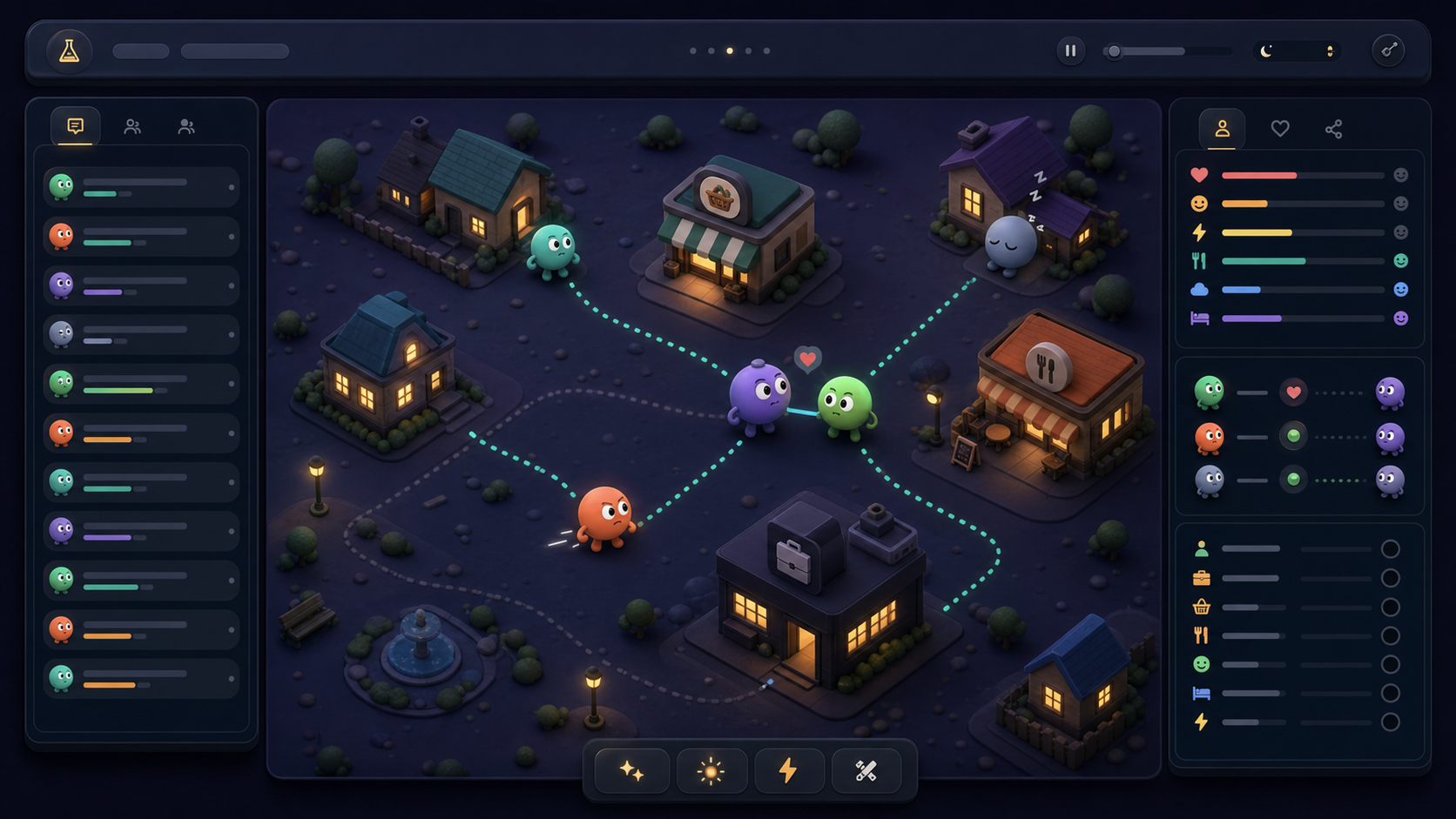
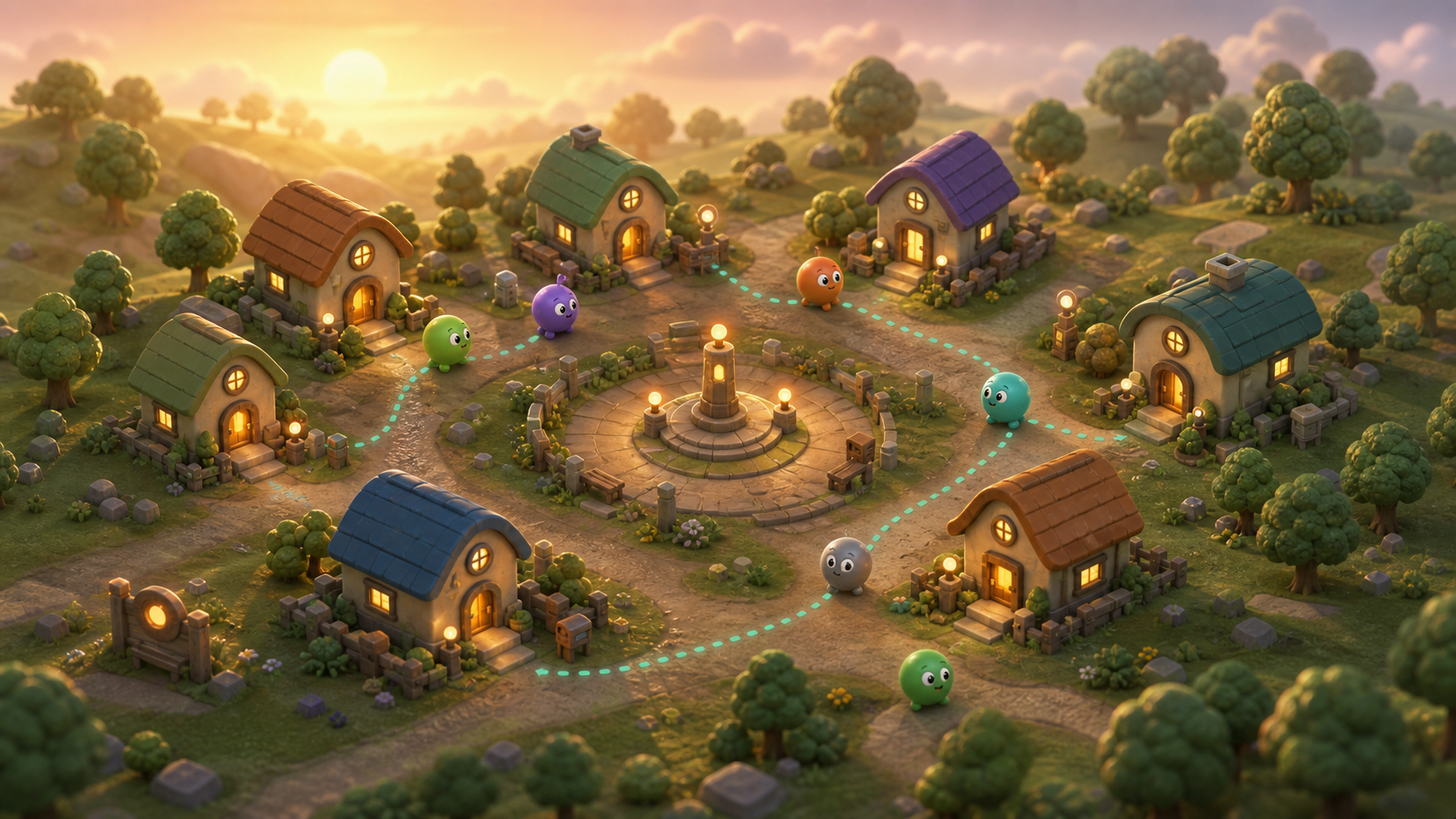
A persistent social sandbox where autonomous Beings keep living, and the user comes back to read what changed.
02
Most virtual worlds still depend on constant control.
They either stop when the user leaves or train the user to optimize every action. Life Lab explores the opposite: attachment to autonomy.
Usual loop
Click, manage, optimize, repeat.
Life Lab loop
Observe, leave, return, interpret.
03
The product is a living town with a chronicler.
Users do not command Beings. They sponsor a beginning, watch a world of needs, work, money, memory and relationships unfold, and return to a readable account of the consequences.
OriginAutonomyAbsenceChronicleAttachment
04
The differentiator is not generated prose. It is traceable consequence.
The engine produces facts. The chronicler selects what left a mark. Language may narrate, but it does not decide what happened.
FactVera looked for Tomás three times.
SystemVera affinity rose. Tomás affinity fell.
“Vera went back to find Tomás. He did not reject her, but every encounter pushed him a little further away.”
05
Current prototype: enough daily pressure for absence to matter.
Autonomous Beings with OCEAN, emotions, needs, homes and routines.
Food, money, work, salary, qualification, unemployment and scarcity.
Asymmetric bonds, affinity, hurt, rumination and decay.
Local persistence, absence simulation, structured facts and first chronicles.
06
Why now: persistent worlds are becoming readable.
Simulation can produce structured social facts; language models can help narrate them; players already understand asynchronous worlds, creator economies and beta communities.
The opportunity is not “AI characters”.
It is a world where autonomy becomes the retention mechanic.
07
Moat: a fact engine before a content engine.
Life Lab’s defensibility comes from accumulated behavioral state: memory, routines, asymmetric bonds, economic pressure, schedules and chronicles that can be audited back to simulated facts.
08
Monetization sells possibility, never destiny.
Founder Being
A remembered origin in the Genesis Zone.
Homes and origins
Context, place and identity without mechanical advantage.
Opportunities
Open doors, never guaranteed outcomes.
Diaries and expression
Premium reading, cosmetics and archives.
09
The scientific angle is a lens, not a claim of prediction.
Life Lab can become an observable social toy-world: useful for curiosity, education, community insight and computational social imagination, while being honest that it does not predict real society.
Psychology: traits, needs, emotion and memory under pressure.
Sociology and anthropology: belonging, rituals, status, conflict and reputation.
Economics and complex systems: scarcity, routes, schedules and unintended effects.
Computational social science: comparable runs, event logs and emergent patterns.
10
Genesis turns beta access into belonging.
Early participants receive a Founder Being and a home in the first remembered zone. It creates community, urgency and identity without selling power.
11
What we are looking for.
Beta testers who understand no-control, advisors in simulation/community/ethics, publisher conversations and aligned seed capital to turn the prototype into a public beta.